Browse Popular Fonts For Mac
Practically everyone who uses a computer knows the operating system includes a number of fonts by default for use in word processing, design, and other tasks where text is important, and macOS is no exception. Many are also familiar with the idea of acquiring more fonts and adding them to the collection, giving even more stylistic options. In order to maintain the fonts on macOS, Apple included the tool Font Book as a way for users to browse the collection, to find the exact font they want to use. The same tool can also manage the fonts on a Mac, including adding and removing fonts, and grouping together similar fonts into smaller collections, such as regularly-used fonts. The Basics Found in the Applications folder, Font Book offers a view of all fonts in a system. The application is ordered into three general columns, consisting of collections and grouping options, the list of fonts, and a preview of the currently-selected font.
The fonts presented on this website are their authors' property, and are either freeware, shareware, demo versions or public domain. The licence mentioned above the download button is just an indication. Please look at the readme-files in the archives or check the indicated author's website for details, and contact him/her if in doubt. Double-click the font in the Finder, then click Install Font in the font preview window that opens. After your Mac validates the font and opens the Font Book app, the font is installed and available for use.
To the right-hand side are a slider and a drop-down box, which can also be typed within. These are used to change the size of the font in the preview section, to show what it looks like in different sizes. The left column shows Collections of fonts, both Smart and user-defined versions, and options to see a list of all fonts installed, those pre-installed, and those added by the user. The middle column lists the fonts in the currently-selected collection.
An arrow next to each font shows the other styles in the font family, such as italic, bold, bold italic, and regular versions. It is possible to change what is shown in the font preview column by selecting the other options in the top-left corner, or entering the View menu on the menubar. The far left option, Sample, shows the A to Z characters of the font in upper and lowercase variants, as well as numerals. The second, Repertoire, shows every symbol a font can display, while the third Custom option allows users to enter their own text in to see how it would look in the font. The fourth option provides more information about the font, such as supported languages, copyright details, and the number of glyphs.
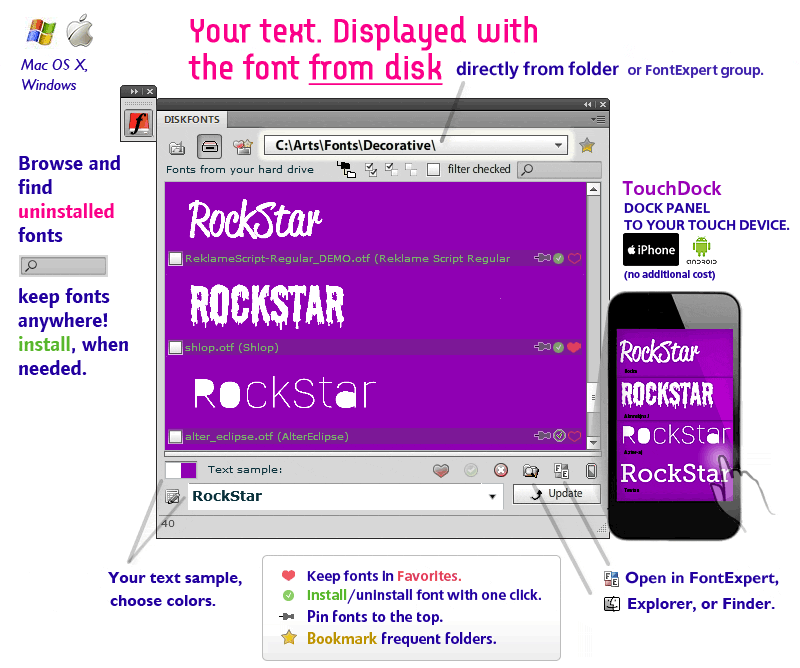
Adding Fonts If you want to add new fonts you have just acquired, there are two ways to do it. The first involves double-clicking the font file to open it in preview. Once open, select Install Font in the lower right corner of the window to import the font. To get rid of a collection, right-click it and select Delete 'Collection Name.' This will remove the collection, but not delete the font. Enabling and Disabling Fonts If you have many fonts on a Mac, the font list in an application may be too long to be useful, and may make it difficult to find what you want.
You can disable fonts in Font Book, preventing rarely-used fonts from appearing on such lists. Select the font or font family in question in Font Book, and either right-click or enter the Edit menu, before selecting Disable Font.
Managing fonts with Font Book It is recommended you use Font Book (included with Mac OS X v10.3 and later) to install, remove, view, organize, validate, enable, and disable fonts. See for detailed information. If you wish to manually manage fonts instead, see the next section. Manually managing fonts Note: Mac OS X has four or more Fonts folders, depending on software installation and number of users. This article differentiates them by pathname.

Free Fonts For Mac Os
To learn more about pathnames, please see:. You may install fonts by double-clicking them and following the on screen prompts in the Font Book application, or by manually copying or dragging font files to any of the standard Fonts folders in Mac OS X. The folder in which a font is located determines who can access and use the font. For example: If a user manually installs a new font at /Library/Fonts/, the font is available only to that user. If a root or admin user installs the same font at /Network/Library/Fonts/, all network users can use the fonts (assuming that the network administrator has set up computers for this type of sharing&rpar. Changes to fonts take effect when an application is opened or a user logs in to the account or computer on which the changes occurred.

Duplicate fonts are resolved based on the order of precedence defined for the standard Fonts folders and are described from highest to lowest priority below. Note: Some fonts are required by applications such as those included with iLife or iWork. If you find that projects related to these applications don't look the way you expect, or if the application no longer opens after disabling a font, try re-enabling the font and check again. Font locations Note: The tilde character () represents a user's Home, which may be local or remote. Font use Font folder location Description 'User' /Library/Fonts/ Each user has complete control over the fonts installed in their Home. These fonts are available to that user when he or she is logged in to the computer.
Fonts installed here are not available to all users of the computer. 'Local' /Library/Fonts/ Any local user of the computer can use fonts installed in this folder. Mac OS X does not require these additional fonts for system operation. An admin user can modify the contents of this folder. This is the recommended location for fonts that are shared among applications.
'Network' /Network/Library/Fonts/ The Network folder is for fonts shared among all users of a local area network. This feature is normally used on network file servers, under the control of a network administrator. 'System' /System/Library/Fonts/ Mac OS X requires fonts in this folder for system use and displays.
Free Fonts For Pages Mac
They should not be manually altered or removed. 'Classic' /System Folder/Fonts/ This folder contains fonts used by the Classic environment (Mac OS X v10.4 or earlier only&rpar. If more than one Mac OS 9.1 System Folder is present, only fonts in the System Folder selected in the Classic pane of System Preferences are used. Classic applications can access only these fonts, not those stored elsewhere. Conversely, Mac OS X applications can use these fonts, even when the Classic environment is not active. &NewLine.