Vectric Forum View Topic
View unanswered posts View active topics. Board index » ShotOnline Forum » Shot Online Official Information » Announcements and Events. All times are UTC - 8 hours. August Event Schedule: Page 1 of 2 [ 20 posts ]. You cannot reply to topics in this forum You cannot edit your posts in this forum. Dec 12, 2018 If this is your first visit, be sure to check out the FAQ by clicking the link above. You may have to register before you can post: click the register link above to proceed. To start viewing messages, select the forum that you want to visit from the selection below. Vectric and VectorArt 3D have teamed up to offer some new Free 3D models (worth $100) for use with Vector Art 3D Machinist and VCarve Pro. We are also running a Free Prize Draw that anyone can enter by downloading the Free VA3D Machinist software and Trial version of VCarve Pro, and simply submitting a design created using a combination of the 2 software products.
Hi folks Can you please tell me if Aspire can create a die, a male model to work as a male die to press copper sheets of metal in a hydraulic press. I want to form copper thickness 0.6 mm so the male die will need to be larger by that amount as I guess.I can see there is an option ' Subtract From Previous Components' which is represented by a U shape, but cant see if you can set the offset - the difference of the male model. Hope its clear for you sorry for my broken English Many thanks for help!
Tommy youre not sure due to it is not a function that works with one click. I tried to explain the process with aspire on vectric forum.one guy picked up and get it quickly. Other just didn't understand at all after 3 times explaining. That's why I don't start to explain here you. With meshmixer is simpler. Look for the bunny example. Make your model you like to achieve.

In any modeler program. Make wallthickness like the sheetmetal you have separate the inner and outer shell of the thickened model. They are the negative and the positive. What you need. I made some screenshots. Actuallyu there are many program makes surface offsetting.
Check on viacad, that is 99 at this time. Or draftsight free, visualcad-freemill also free. All of them can make it on the pictures I used meshmixer first import your model, select all edit extrude in extrude functiuon, select extrusion not by axis, but by normals. Set direction as positive-negative, or say in-out set the thickness you want. Next the outer-inner shell need to be separated the two will gives the two mold. Just a remark, that modelpreview that made program, that possible also can make your surface offset. Tommy can I ask you what type is this press?
Reason I asking, where I was living before 2000 there was a factory, for cooking pot and similar household stuff. They used hydraulic presses. And process was not always so smooth:-) in fact til a product got in production, there was several try. Sometime they had to send back a whole pallet sheetmetal to the supplier due the steel was not for this purpose.
Simply tear randomly in first or second step. When I saw your post, and your original drawing, shows a 'tray' now, if that molds not radiused properly on edges and theres no left a 'gap' then it will cut out the tray instead making it. The industry using some another methods. For the purpose you need this, I think a simple rubber plate could substitute the negative. Means you make the stamp or male part and a silicon rubber plate will be sufficient. Fr decorative purposes example using a soft copper material you can lay some steel wirenet on the press lay onto the coppersheet top with a rubber and you get a nice texturing on the copper.
Without making any mold. Cut shapes out of sheetmetal and emboss into copper. Lot simpler than it looking. For your other question. Meshmixer doesn't create toolpaths. Pending on your future plan, and how much you plan invest right now you can try freemill.
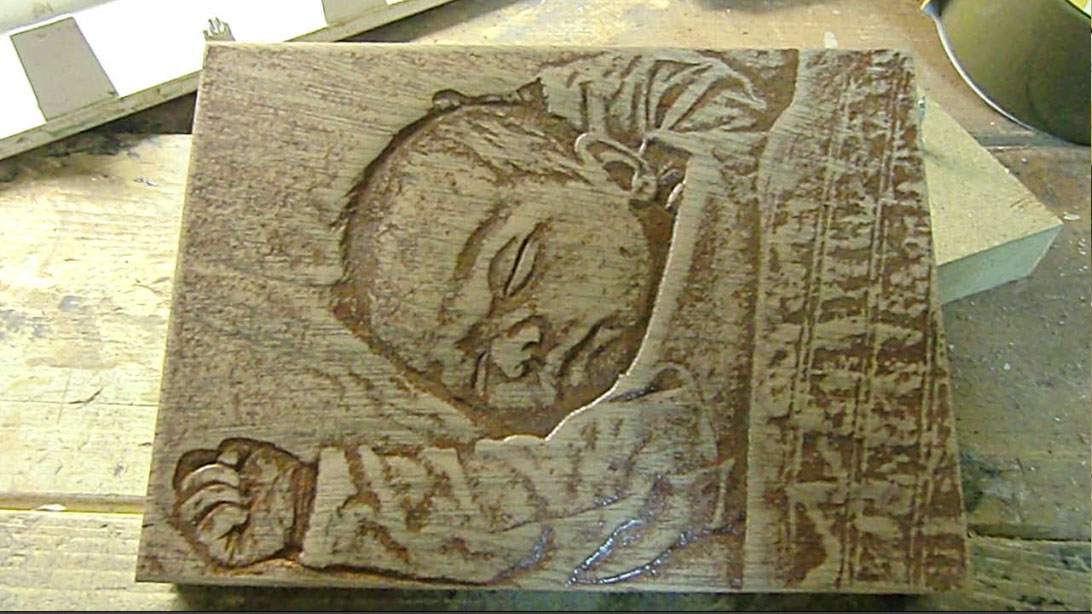
That makes toolpath for your male part. As its name says its free.
I have around 50 ton hydraulic press. I did samples out of copper 0.3mm - acrylic die and a rubber and it looks ok as for decorative items but the copper thickness 0,3mm is too small if I wish to make a proper tiles to install on the wall. My ideal finished product would be like this and 0,6mm thick ( more here ) And I hope I be able to get right result on my press and a die made of aluminium or some hard plastic component. The problem may be with corners to make a tray, not too hight but around 3-5 mm should be enough. Tommy since it is for decorative purpose.
Corners can be rounded, also try to void vertical walls. Sample you posted is not a deep depress. The 5 mm for 0.6 sheet is I think too much. Thinking on a concrete edge. 5 mm can be achieved like a dome height, where edges are relatively low. Oulines, or call conturs can have 40-50 deg angle. Try to go first with low cost programs, and later invest something what match to your ideas.
If you make a business of this. I think first series you even can make with handmade molds.
You need a scrollsaw with metal blade cut the positive shape and cut larger the negative likely 1mm gap. And it will work. Same thickness can be used for the negative and positive. If you draw a crossection, then youll see it why. Personally me, I using silo3d what is 80 dollar right now.
Vectric Tutorials
Hexagon will make all your models and cost 20. Little extra work with but youre capable to model even organic models, like a leaf or similar. Go with these. Actually for flat shapes manual work is ok. When you try to make some relief like tile then you need modeling program. Start another topic, in a general area.
And I can help you more. Based on the 2D nature of your posted example, I don't see why you can't do two different halves. One raised and one recessed. The recessed version needs to be adjusted by the thickness of the material you intend to use, and that can be done easily with the. One of the halves needs to be mirrored so that when you flip it over for your press, it will actually mate up with the proper orientation. You will have to adjust the corners by the diameter of the end mil you are using, so you don't have sharp external corners and rounder internal corners. I did a couple 2 minute down-n-dirty examples below.
Now, if you were talking about an undulating 2.5D male/female, the steps are more involved, but the principle is the same.
Dan I have never made one of these, but if you have Art-Cam Pro, you can model it and make it. You will need to figure out how you want to hold it in place while machining the bottom, then turn it over and machine the top. I would do it in that order so your last cutting is on the side that is visable when installed. I would think this one would take a long time to mill.
I have always marvaled at these. If I were you I would Go shopping for the stair parts on Google. You will find what you need and you can't compete with those prices. There is a somewhat related thread on the Vectric forum about machining a similar spiral using a fluting toolpath, which might be faster, though the Vectric discussion relates to a corbel, not a railing. Concerning the bottom of the railing, there are companies that sell router or shaper bits to directly cut the profile on the bottom of the railing.
You'd have to find one that matched, but it might be easier to cut the part to shape, then just use a router table or shaper to cut the bottom profile. Magnate and MLCS both sell handrail bits, though they might not match your profile.