Install Windows Xp From Network Tftpd32 For Mac
VERY IMPORTANT Prerequisites There are many things you need to prepare beforehand, so that everything works smoothly. Please don't skip any of these elements or the likelihood of failure will be high:. You need to download and extract a little tool named. Download the appropriate version for your operating system (32-bit or 64-bit). You will notice that there are a 'Non-Supporter' version and a 'Supporter' version. The free one is the 'Non-Supporter' version.
It includes a small annoyance when you start it, plus a few limitations that won't impact you unless you are a network admin or IT professional who needs to install lots of operating systems on many network computers. If you are such a professional, go ahead and purchase the 'Supporter' version which costs a fair $29.99. This software is a bit finicky.
Connect the 2 PCs using the crossed network cable. Configure the CD disabled com to PXE boot from bios. Configuring Tftpd32, 3.1 Install Tftpd32 and Make a subdirectory in your pxe folder called 'pxelinux.cfg' (despite the '.cfg' this is a folder, not a file) 3.2 In your pxelinux.cfg folder create a new text document and open it using notepad. Apr 1, 2011 - This machine must have a Windows installation in a shared folder.
It doesn't like long folder structures and installation folders, spaces and special characters. Therefore, extract it in a folder with a short name, directly on the root of one of your computer's partitions. For example, I extracted it at 'D: SERVA'. Choose a similar path on your computer. You need the original installation files for the operating system(s) you want to install over the network. Have them at hand as you will need to copy them to a special folder, as they are, without modifications.
For the computers where you are about to install Windows over the network, identify their exact network card model(s). Then, download the appropriate drivers for the Windows version you are about to install on them. By default, Windows setup programs support a limited number of network cards.
If your system is rather new, then it is very likely that it won't support its network card and the installation procedure will fail. Every time you run Serva,. This way it has the required permissions to create files, save the settings you make, etc.
When you run Serva, make sure that it is not blocked by your firewall. The application must be set as allowed on the computer where it runs, otherwise it won't be able to transfer anything over the network. The computer where the installation files are stored and the one where you want to install Windows must be part of the same network. This means that you have a router on your home network, managing network IP addresses and network traffic. If not, then you should directly connect the two computers with a.
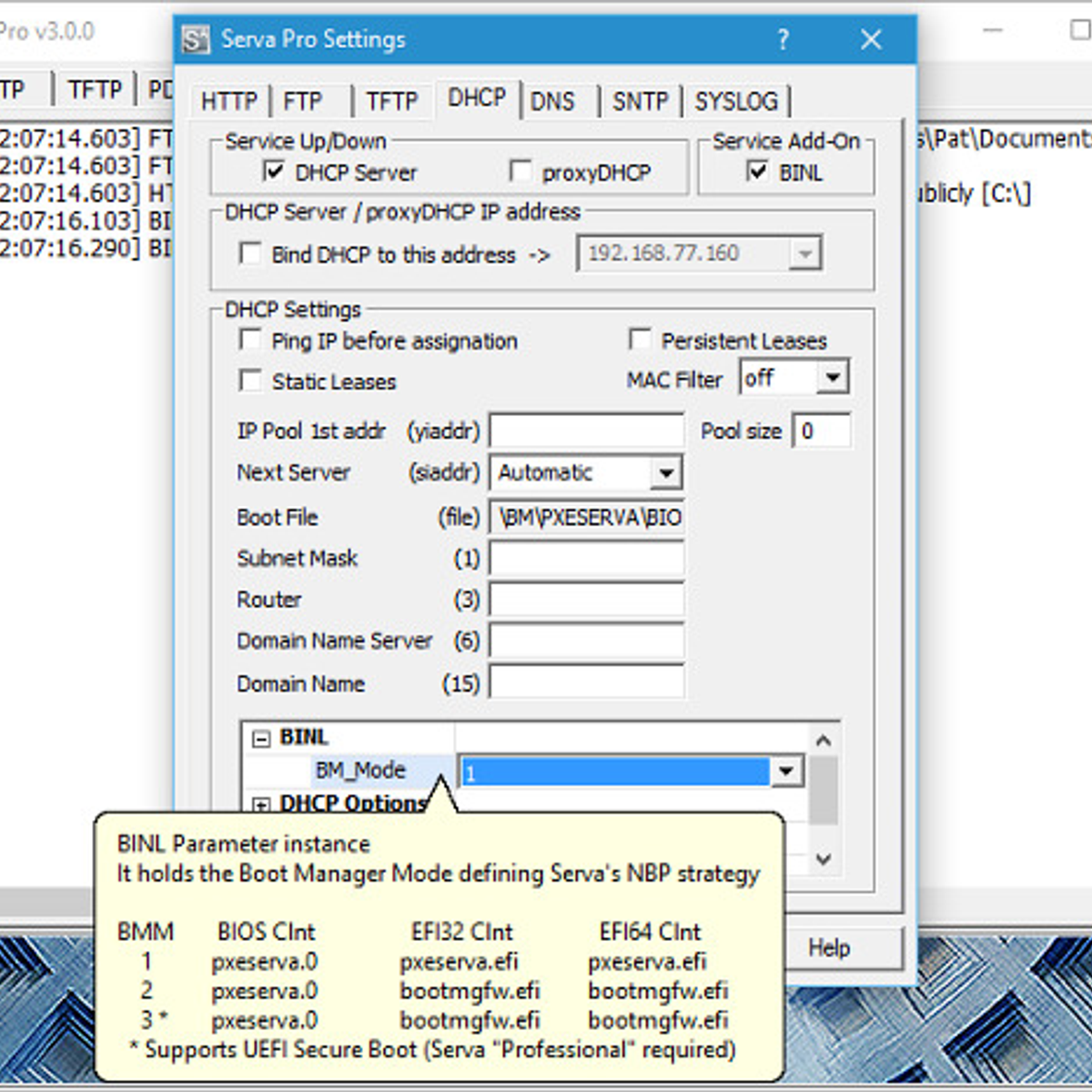
Step 1 - Run Serva & Make Its Initial Configuration Run Serva as administrator. The free version will ask you to wait for 7 seconds before you can use it. Once the wait is over, click 'Thanks, not today'. BINL is a special add-on that acts as a DHCP protocol extension and it is used by Serva during its preparation and maintenance procedures. ProxyDHCP is a special setting that tells Serva that it doesn't need to act as a DCHP server in order to provide IP addresses to the computers connecting to it. Even though Serva's developers don't recommending enabling this setting, we have learned in our testing that it helps eliminate some issues. Therefore, also enable the box which says 'Bind DHCP to this address' and leave the default IP address that is provided.
There is no need to modify other settings in this tab. Next, go to the TFTP tab.
TFTP comes from and it is the protocol used by Serva to transfer files over the network. This protocol needs a bit of configuration as well. First, check the box near TFTP Server. Then, you need to specify the so called 'root' directory. This is the directory where you plan to store the Windows installation files. This folder can be the same folder where you extracted Serva or a new one. Keep in mind that you should use short paths and avoid using spaces and special characters (., &, ', etc) in the directory name or its path.
Amongst those folders, you must find one named WIAWDS and another named WIARIS. If they are not found inside the root folder you specified, something went wrong with Serva's configuration. If all is well, go ahead and read the next section in this article.
Step 2 - Copy the Windows Installation Files Go to the root folder you specified. Here, you need to copy the Windows installation files, as they are, without any modifications from your side. If you want to install older versions of Windows like Windows XP or Windows 2000, you need to copy those files in the WIARIS folder. Since these operating systems are very old and we don't recommend using them, we won't provide specific instructions for them. If you plan to install Windows Vista, Windows 7 or Windows 8, then open the WIAWDS folder. There, create a new folder named according to the Windows version you want to copy. Use simple folder names, with no spaces or special characters.
For example, I used Windows7. Create separate folders, with different names for all the Windows versions you plan to install over the network, using Serva. Inside that folder, copy and paste all the installation files for the Windows version you want to install over the network. Simply go to the root of the installation disc, and copy its entire file and folder structure. Step 3 - Start Serva Start Serva again, as administrator and wait for it to detect the installation files you added. It will create its special folder structure, required to distribute the installation files over the network.
Then, close Serva and go to the next step. Step 4 - Copy the Network Card Driver(s) Next, you need to copy the network card drivers for the computer(s) on which you want to install Windows.
Go the folder where you copied the installation files. In my case it was 'D: serva' (both the root and Serva installation folder), followed by 'WIAWDS Windows7'. There, go to '$OEM$ $1 Drivers NIC'. If you can't find these folders, create them yourself.
Then, extract the network card drivers and place them inside. If your drivers come as a setup.exe or as a self-extractable archive, extract it first. Make sure the driver's '.inf' and '.cat' files are stored directly in the NIC folder. Step 5 - Share WIAWDS Folder with the Network In order for Serva to distribute the Windows installation files over the network, they need to be shared with the network, so that other computers can access them.
Unfortunately, Serva requires you to share the WIAWDS folder (and not its subfolders or other folders) using a very specific share name: WIAWDSSHARE. Using any other share name means that the installation procedure is likely to fail. To share this folder with the name we mentioned, you first need to enable advanced sharing in Windows and then share it. Here's how advanced sharing works in Windows:. You must give the user Everyone read-only permissions. You can also share this folder with specific user accounts, whose login details you will use later on, during the network installation process. Again, read-only permissions are enough.
Step 6 - Start Serva Start Serva again, using administrator permissions. It will detect the network drivers you added and make a few changes, so that the drivers are distributed correctly when you launch the installation process on other computers. You can now leave it open and waiting for network connections. Next, go to the computer(s) where you want to install Windows.
Step 7 - On the Target PC - Enable Lan Booting & Boot from the Network Go to the computer where you want to install Windows and enter its BIOS. Make sure networking booting is enabled. This setting can be named 'Boot from the network' or 'Boot from PXE'. Then, start the computer and press the required key to bring up the Boot Menu. On most computers, you need to press F12 or F8, depending on the BIOS version.
Select Network or PXE (again, this depends on your computer's BIOS), to boot from the network, using Serva. The installation files are loaded and a small window named ServaPENet is shown. At this step, Serva installs the network driver you added earlier, loads network resources and connects to the Windows installation folder. Depending on how you shared the WIAWDS folder, it will ask you to provide a username and password to access it. Type the details of the user account you shared it with and connect.
If all went well, the Windows installation process is now started. Step 8 - Install Windows Over the Network Next, continue with the Windows installation, as usual. If you plan to install Windows 8, check this installation guide:. If you plan to instal Windows 7, check this article:. Troubleshooting Problems with Serva If you don't pay attention to all the steps in this procedure, some things are likely to fail. Here are some things we learned while experimenting with this tool:. If ServaPENet returns this error: 'Failed No NIC/Driver, Aborting!'

, it means that you forgot to copy the network card drivers as instructed at Step 4. If you copied them and you still get the error, double check that you have the correct driver for the network card of the computer where you want to install Windows, for the Windows version you are about to install. Also, double check that you copied it to the correct folder. Then, restart Serva to make sure it detects the driver before the network installation procedure starts. If, on the target computer, Serva is not able to load at all over the network, consider enabling the 'Bind DHCP to this address' and 'Bind TFTP to this address' settings in the DHCP and TFTP tabs.
If you connected two computers directly, with a crossover cable, you need to set Serva as DHCP server, in order for everything to work. This means setting the 1st address available in the IP pool, the pool size, and the subnet mask to be used when Serva assigns IP addresses. One last piece of advice is to check the Serva logs.
The messages shown there can help you troubleshoot different problems. Another good tip is to restart Serva every time you change any of its settings and every time you add something to its root folder. Since we are not the developers of this software, we cannot provide support for it and help you with all the issues you might encounter. If our guide does not help you, then double check Serva's documentation - and advanced configuration guide -.
Install Windows Xp From Network Tftpd32 For Mac Mac
Conclusion As you can see from this guide, setting things up with Serva requires quite a bit of time and attention. However, it is the simplest way of installing any modern version of Windows over the network. It works great both for home networks and small or medium sized business networks. If you know other useful tools for installing Windows over the network, don't hesitate to share them using the comments form below. Discover more:,.
Scanning documents, business cards, and other types of printed text, with your smartphone, has become commonplace. It usually involves an app that can do the scanning for you and some post-processing. Microsoft managed to make things even easier than that, by implementing a scanning feature directly in its OneDrive apps for Android and iOS (iPhone and iPad). This feature is built into the OneDrive app and it is easy to access and use. It also automatically saves everything you scan to your OneDrive cloud storage. Windows 10 has become the most popular PC operating system in the world. Regardless of whether you already have Windows 10 or not, you might want to keep an ISO file with the Windows 10 setup around.
You never know when you might need it: upgrading an older Windows 7 or Windows 8.1 PC, reinstalling your Windows 10 or helping a friend in need, when his or her computer breaks. If you want to know how and where to download Windows 10, worry not.
Here are three ways to download Windows 10 for free and completely legal. TP-Link is famous for its affordably priced home networking products. They manufacture not only wireless routers but also mesh WiFi systems.
Their top-selling product in this niche is Deco M5, which now has a new v2 variant, which brings several quality-of-life improvements compared to the first model. We very much enjoyed testing TP-Link Deco M5 v1, and we were curious to see whether v2 is an even better model. Read this review and find out whether TP-Link Deco M5 is a great choice for your smart home.
Installing just one copy of Windows XP on a desktop can be a tedious enough job. But multiply that task by ten, twenty, a hundred or more and it becomes a truly daunting prospect. Just imagine having to sit there filling in the CD-key, regional and language settings, entering the computer name and workgroup settings for every single machine in a batch of a hundred.
It hardly bears thinking about. Fortunately, there are methods that the downtrodden systems administrator can employ to get around the tedium of a multi-machine install. One of the simplest methods to do this is to run what's called an Unattended Installation.
This allows one-click installation of Windows XP, either over a network or from a CD, and over the course of the next few pages, we'll be showing you exactly how it's done.